Genworth Canada Releases Spring 2013 Metropolitan Housing Outlook
TORONTO, June 25, 2013 /CNW/ - After three years of varied periods of
growth and decline across the country, the Canadian housing market is
starting to stabilize, according to the latest housing report released
by Genworth Canada. While the economy continues to strengthen, modest
growth in the housing market is the trend for the next five years.
"The Canadian housing market is transitioning to a balanced level of
supply and demand," said
Brian Hurley
, Chairman and CEO of Genworth
Canada. "While lower demand has cooled the housing market, this latest
research shows moderate growth over the next few years which points
towards a more stable market for both buyers and sellers."
The current condition is due in part to the tightening of regulations,
but also continued warnings to consumers on their debt levels.
Consumers appear to be heeding the advice and stabilizing their
financial position before the Bank of Canada begins to raise its rate.
The Spring 2013 Metropolitan Housing Outlook notes that healthy employment gains since the end of the recession have
helped move mortgage payments in arrears and bankruptcies to a downward
trend, except in British Columbia where payments in arrears have
flattened after an upward trend from 2008 to 2010. Despite the low
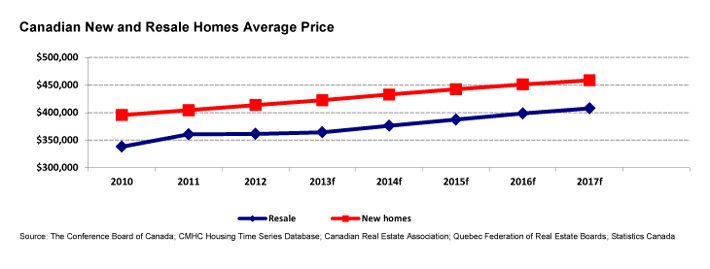
interest rates, price growth for both new and existing homes has been
decelerating. The report also notes that while total mortgage
approvals are falling, this decline is entirely fuelled by resale
homes, as mortgage approvals for new homes increased by 3.4 per cent.
Regional Highlights
-
Atlantic Canada has seen large growth in housing starts, but with
population growth low, the strengthening economy will not be able to
keep housing starts from declining, as they align with demographic
needs
-
Quebec consumers will enjoy good employment and income growth, but
government cutbacks and nervous consumers will put a lid on housing
demand, bringing about a contraction in housing starts this year and in
2014
-
Ontario may be on its way to experience in 2013 its first decline in
housing starts in four years, but as the economy continues to grow and
unemployment declines, new home construction is expected to rise again
in 2014
-
The Prairies are experiencing the strongest growth in home pricing,
propelled by strong economic growth, rising employment and sustained
residential demand
-
Alberta saw the greatest population growth among the six regions, as
well as housing starts surging to a post-recession high in 2012;
housing starts are expected to continue to grow through 2013 and 2014
-
British Columbia, after a period of huge growth and then huge
correction, is finally settling into more balanced market conditions
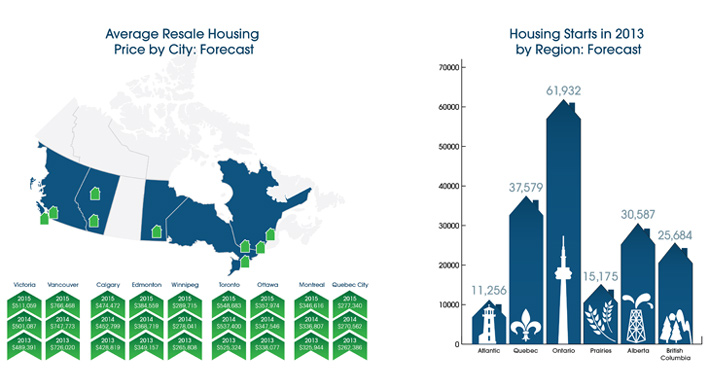
Prices for existing homes are expected to rise this year in eight of the
nine cities studied and in all nine cities by 2014. Vancouver will
remain the most expensive city, with the average resale house price
forecasted to reach $766,468 by 2015, an increase of more than 5.5 per
cent from 2013. Calgary will see the greatest relative increase in
housing prices over the next three years, with Edmonton and Winnipeg
close behind. The rest of the metropolitan areas will experience more
moderate growth closer to the national average.
Average Resale Housing Price by City: Forecast
|
City
|
2013f
|
2014f
|
2015f
|
|
Québec City
|
$262,386
2.4
|
$270,562
3.1
|
$277,340
2.5
|
|
Montréal
|
$325,944
2.4
|
$336,807
3.3
|
$346,616
2.9
|
|
Ottawa
|
$338,077
2.8
|
$347,546
2.8
|
$357,974
3.0
|
|
Toronto
|
$525,324
0.9
|
$537,400
2.3
|
$548,683
2.1
|
|
Winnipeg
|
$265,808
4.2
|
$278,041
4.6
|
$289,715
4.2
|
|
Calgary
|
$428,819
4.0
|
$452,799
5.6
|
$474,472
4.8
|
|
Edmonton
|
$349,157
3.7
|
$368,719
5.6
|
$384,559
4.3
|
Vancouver
|
$726,020
-0.6
|
$747,773
3.0
|
$766,468
2.5
|
|
Victoria
|
$489,391
1.1
|
$501,087
2.4
|
$511,059
2.0
|
Italics indicate percentage change from previous year.
Sources: The Conference Board of Canada; Canadian Real Estate
Association;
Québec Federation of Real Estate Boards.
The Metropolitan Housing Outlook, which is produced twice a year, is
commissioned by Genworth Canada from the Conference Board of Canada.
The report reviews a wide range of housing statistics and offers
in-depth analysis of the trends in the housing market for Canada, the
Provinces and nine metropolitan areas: Québec City, Montréal, Ottawa,
Toronto, Winnipeg, Calgary, Edmonton, Vancouver and Victoria.
A copy of
the report is available at
http://genworth.ca/en/pdfs/Metro_Housing_Spring_2013.pdf .
About Genworth Canada
Genworth MI Canada Inc. (TSX: MIC) through its subsidiary, Genworth
Financial Mortgage Insurance Company Canada (Genworth Canada), is the
largest private residential mortgage insurer in Canada. The Company
provides mortgage default insurance to Canadian residential mortgage
lenders, making homeownership more accessible to first-time homebuyers.
Genworth Canada differentiates itself through superior customer
service, innovative processing technology and a robust risk management
framework. For almost two decades, Genworth Canada has supported the
housing market by providing thought leadership and a focus on the
safety and soundness of the mortgage finance system. As at March 31,
2013, Genworth Canada, had $5.7 billion total assets and $3.0 billion
shareholders' equity. Find out more at www.genworth.ca.